

Faceless YouTube channels stall for different reasons, and the cause isn’t always a bad niche or a lack of uploads. Sometimes growth slows because viewers stop clicking, retention drops, topics become repetitive, or the channel simply stops giving its audience something new.
CONTENTS
- 1. Faceless YouTube Channels Stall When the First Audience Stops Growing
- 2. Repetitive Content Makes Faceless YouTube Channels Stall
- 3. Your Titles and Thumbnails Are Losing Their Pull
- 4. Weak Audience Retention Can Stop Faceless YouTube Channel Growth
- 5. Faceless YouTube Channels Stall When Video Quality Stops Improving
- Fix the Weakest Part of Your Production
- 6. Weak Audience Engagement Can Make Faceless YouTube Channels Stall
- 7. Chasing Revenue Too Early Can Stall a Faceless YouTube Channel
- Final Thoughts: Why Faceless YouTube Channels Stall
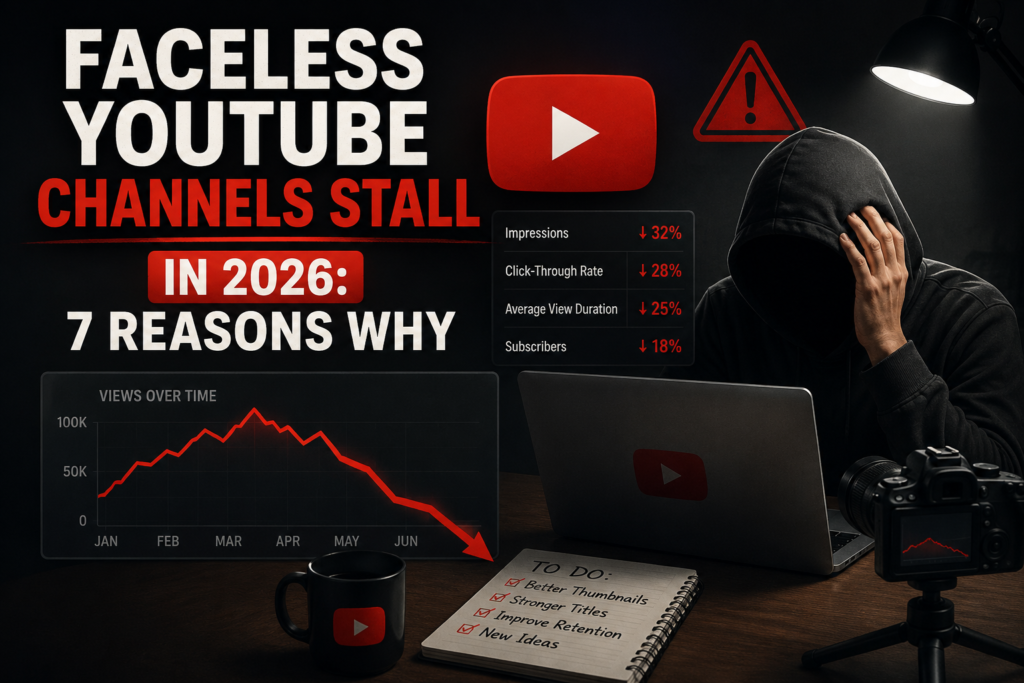
Faceless YouTube channels stall when the videos that once brought steady views stop getting the same response. Impressions may drop, new uploads struggle to gain traction, and growth can suddenly feel much slower even when you’re still publishing consistently.
A slowdown does not always mean the niche has stopped working. Your audience may simply be responding less to recent uploads. Repetitive topics, weaker titles, predictable formats, or lower watch time can all contribute.
Many stalled channels can recover. Instead of publishing more videos and hoping for a change, identify what is slowing the channel down first. Below are seven common reasons growth can stall.
1. Faceless YouTube Channels Stall When the First Audience Stops Growing
A new channel can grow quickly before YouTube fully understands its audience. Some early videos may even outperform expectations. But that first audience can become saturated if future uploads keep covering similar ideas.
In many cases, faceless YouTube channels stall because the packaging no longer gives viewers a strong enough reason to click.
Most faceless channels rely on a few core ideas. New titles and thumbnails cannot hide repeated promises forever. Returning viewers quickly notice when several videos offer essentially the same thing.
When you have created a lot of content, you can first expand on it. For example, a beginner tutorial is immediately followed by an advanced tutorial. A list of tools is compared one by one. A general explanation is concretized by sharing an example, or by conducting an experiment or sharing a case study. In short: you can respond to the problems that your viewers are facing.
You should look at the last few uploads to your faceless YouTube channel as a group rather than individually. If there are a few videos that ask the same questions and manage to reach a few people each, then growth will be hindered by the topic of repetition rather than by a lack of consistency in your publishing.
This objective does not aim to abandon core audiences but rather to give them reasons to return and watch new content that can also attract new audiences.
2. Repetitive Content Makes Faceless YouTube Channels Stall
Consistency is important to recognize a channel, but repetition has the opposite effect. Every upload with the same opening, same pace, same images and same ending, after a while, even before the end of the video, the viewer will know what’s coming.
This problem can be easy to miss with faceless content. Templates, AI voices, stock footage, and repeated script structures make production faster. But using the same format too often can make every upload feel identical.
This is one reason faceless YouTube channels stall even when creators continue publishing consistently. More uploads won’t solve the problem if viewers feel they are seeing the same video again and again.
Watch your most recent videos without looking at the titles to them. Would a viewer even know that you had done a different video? If not, changing a few keywords or reworking a thumbnail will not solve the core problem.
Save time and variety where it will have the greatest impact. In the above examples, rather than another list-based video, create a case study video for example, using the original examples but with different pacing and a stronger opening. Use YouTube content automation to make the production of videos easier, not to make every video that you produce interchangeable.
3. Your Titles and Thumbnails Are Losing Their Pull
Sometimes the content itself isn’t the first thing holding a channel back. The problem happens before anyone watches the video.
As your video is normally shown next to other videos on the homepage or in the search results, the title of your video needs to stand out from the others. Also the thumbnail of your video needs to differ from the thumbnails of your other videos, otherwise the viewer might choose another video instead.
Compare falling views with impressions and click-through rate. These metrics can show whether the real problem is the title or thumbnail. Do this before changing the niche or your entire content strategy.
This analysis between the best and worst videos of yours will help to see the main differences between them in terms of the promise, clarity, curiosity and the visual simplicity of your videos. Thus you get much more out of this analysis than from using a template of another creator.
In many cases, faceless YouTube channels stall because several small problems build up at the same time. A weaker thumbnail, lower retention, repetitive topics, and declining engagement can gradually slow the entire channel.
When testing changes to your video page, make sure to test one change at a time. Based on how your users react to the change, you can then make the next change. Before users have to click on the play button, they should be able to get a sense of the value that your video can bring to them.
4. Weak Audience Retention Can Stop Faceless YouTube Channel Growth
Winning the click is only half the job. If viewers leave shortly after the video begins, a strong title and thumbnail won’t carry the channel very far.
Long introductions, too much explanation of obvious points, generic AI transitions and too many calls to action can give the impression that your video is wasting the viewer’s time.
Audience-retention reports for your video will show where viewers drop off, including during the introduction to your video. Any long-winded explanations will likely lose your viewers. Look for the parts where your video seems to hold your viewers’ attention in particular and find out what made them different.
Pacing matters more in faceless videos because there is no on-camera personality to carry slower sections.
To that end, all elements of a faceless video — including the script, the narration, the visuals, the editing, and the examples — must work well together to sustain the experience of watching such a video.
Stop trying to hit some arbitrary retention percentage. Every video on YouTube is different. So, use the YouTube audience retention report to diagnose where your video of interest is dropping off. Then, get a sense of what is happening. And, finally, use that knowledge to make the next video even better.
5. Faceless YouTube Channels Stall When Video Quality Stops Improving
A faceless channel does not need expensive cameras or cinematic production to get views.
. But as time goes on, the experience of watching your channel needs to get better. If after dozens of videos your videos still look and sound the same then there are plenty of other competitors that are continually improving, meaning that they will be more interesting to your viewers.
Some of the problems in your videos are very subtle. Although you are probably saying something useful in your videos, the audio may not be strong enough. In addition, you are probably using a lot of the same old stock footage. The narration of your videos may sound too robotic. Also, your videos may be too slow and the editing may be too predictable. In faceless videos, these are very important details because there is no on-camera personality in your videos.
Fix the Weakest Part of Your Production
Rather than building a brand new production system from scratch, it’s much more sensible to identify the weakest link and work on fixing that first. If your VO sounds unnatural, then work on your narration. If long sections of your program are dull and are boring your viewers to tears, then work on editing those sections down. And if every scene in your program is using generic, unoriginal stock footage, then think about incorporating some screen shots, graphics, examples, etc. that actually support what you’re saying in that scene.
Over time, faceless YouTube channels stall when production becomes too predictable and viewers stop noticing meaningful improvements. Even small upgrades in narration, pacing, visuals, or editing can make the content feel fresh again.
As the channel grows, the production quality should improve. A faceless YouTube channel can quickly reach a plateau as the workflow becomes so automated that efficiency overrides quality. Automation is supposed to help you make better content, faster, not the same old stuff over and over again.
6. Weak Audience Engagement Can Make Faceless YouTube Channels Stall
One popular video does not mean viewers are interested in the rest of the channel.
In fact, if lots of people only watch one video and then go back to whatever they were doing, it will be very hard to get more views.
Building a connection can be harder when no personality appears on camera.
However, the connection with the content creator can be established by consistent voice, useful opinions, regular formats, stories etc. and reasons to subscribe to a channel.
Stop putting generic “like and subscribe” messages at the end of your videos, and give your viewers something to respond to. For example, ask your viewers which tool they would use in a given scenario, ask them to suggest a problem for you to try and solve in a future video, or ask them if they agree with your conclusions in a video. The comments on your videos can reveal topics that you would never have found through keyword research.
Pay attention to returning viewers as well. A channel that attracts people back for future videos is building something stronger than a collection of isolated uploads. The goal is not engagement for the sake of a metric—it is creating an audience that recognizes the channel and wants to see what comes next.
7. Chasing Revenue Too Early Can Stall a Faceless YouTube Channel
Money may have been the driving force to start a channel but soon it can start to dictate every decision around content if it is allowed to too early on.
Creators can see that topics around finance, software and AI have a high potential for monetization. Therefore, they can publish content around these topics, even if they are not within the main focus of their audience. A second creator can extend simple video ideas and publish them as longer videos. He can also put too many affiliate links in his video descriptions and repeat the coverage of products with high commissions over and over again.
While this may work in the short-term, the main risk is that the audience will get confused as to why they signed up to the channel in the first place. By serving up videos that are around the highest paying offer for that audience, the channel’s clear identity will be undermined and the reason it got so many subscribers in the first place will be lost.
Audience and monetization strategy are to be built simultaneously. One has to recommend products that fit a topic, create commercial videos to solve problems of the viewers and put up enough information-based content to maintain the viewers’ trust.
Another reason faceless YouTube channels stall is that creators start making decisions around revenue instead of viewer needs. When monetization changes what the channel originally promised, returning viewers may gradually lose interest.
A faceless, profitable channel is necessary to generate revenue. However, more than the reason for every upload, revenue succeeds as a result of the value of an audience. If monetization is allowed to control the editorial, even the best produced channel will lose momentum at some point.
Final Thoughts: Why Faceless YouTube Channels Stall
Stalled faceless YouTube channels aren’t always solvable by just making and publishing more videos. They often need better topics, packaging, higher retention, fresher production and above all a better understanding of what their audience really wants.
Watching a single video as a problem does not work. Watching your channel as a system does. See which of your videos are still being watched, where your viewers drop off and how you can get them back to your videos on topics that are of interest to them. That will give you a much better impression of what is going on on your channel than just looking at your view count which is decreasing.
Automating as much content as possible is not the end goal, you want to create a process that continues to improve. The main use of AI and automation is to take away the mundane work for you to then focus on the research, the creative decisions and the best possible viewer experience for your channel.

