
Can TubeBuddy Keyword Explorer help a small YouTube channel identify low-competition topics worth testing? For newer creators, competing with established channels on broad subjects can be difficult, especially when every video targets the same popular search terms.
- Key Takeaways
- What TubeBuddy Keyword Explorer Can Help You Discover
- Set Up a Practical Keyword Research Starting Point
- Find Keyword Ideas With TubeBuddy Keyword Explorer
- Start With Specific Seed Keywords
- Expand Ideas From Viewer Questions
- Build a Working Keyword List
- Check Search Demand and Keyword Competition
- Interpret Search Volume Carefully
- Compare Competition With Channel Strength
- Look Beyond a Single Keyword Score
- Judge Whether a Keyword Fits Your Audience
- Turn Keyword Data Into Stronger Video Topics
- Move From a Phrase to a Clear Viewer Promise
- Choose an Angle a Small Channel Can Serve
- Plan Titles Without Keyword Stuffing
- Compare Realistic Opportunities in a Mini Case Study
- Example: Selecting a Topic for a Faceless Channel
- Record the Evidence Behind Each Option
- Leave Space for Real Case-Study Data
- Common TubeBuddy Keyword Research Mistakes and Limitations
- Mistaking Low Competition for Guaranteed Success
- Ignoring Search Intent and Existing Results
- Relying on One Tool or One Metric
- Overlooking Content Quality and Packaging
- Choose the Strongest Keyword Opportunity Before Publishing
- Validate the Final Keyword Before Production
- Conclusion
- FAQ
- What is the primary function of the TubeBuddy Keyword Explorer?
- How can small and faceless YouTube channels benefit from proper keyword research?
- How do I define my research subject before opening the TubeBuddy keyword tool?
- What metrics should I look at besides search volume and keyword competition?
- Why is a relevance filter necessary after checking demand and competition?
- How do I turn raw keyword data into a compelling title and video promise?
- What are the most common mistakes creators make with the TubeBuddy keyword tool?
A practical workflow helps you compare audience interest with keyword competition before investing time in production. This guide explains how to use the keyword explorer, interpret its estimates, and assess whether an opportunity fits your channel rather than promising guaranteed rankings or views.
Use those signals alongside audience knowledge, live results, and the quality of your planned video.
Key Takeaways
- Identify realistic topic opportunities for small channels.
- Compare estimated search volume with keyword competition.
- Build a focused list of keywords before producing videos.
- Check whether a topic matches your audience and format.
- Use TubeBuddy data to inform, not replace, your YouTube optimization strategy.
What TubeBuddy Keyword Explorer Can Help You Discover
Using the TubeBuddy Keyword Explorer helps you compare possible video topics before spending time on production. The keyword explorer does not create a complete content plan or guarantee a top ranking, but it can organize useful signals for your research.
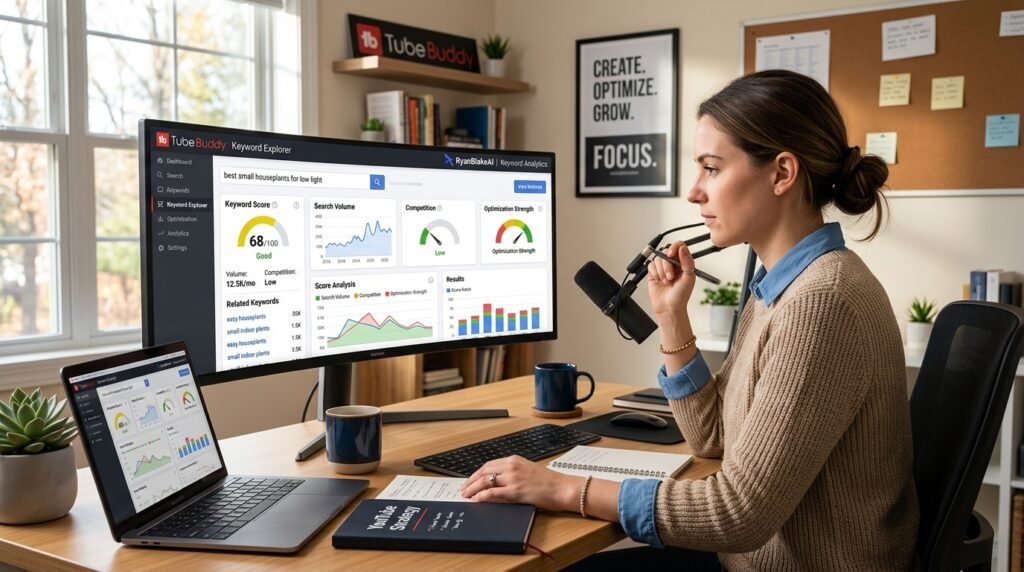
The TubeBuddy keyword tool may show estimated search volume, keyword competition, trends, related suggestions, and a combined Keyword Score, depending on your account and current interface. Treat these figures as directional rather than real-time promises. A low-competition keyword can still have too little demand to get views, while a high-volume term may attract many competing videos.
For a smaller channel, broad subjects such as “fitness” or “cooking” are difficult to target directly. A more specific phrase, such as “meal prep for one in a small apartment,” gives your video a clearer audience and purpose.
For a faceless channel, low-competition youtube keywords can guide formats that do not require an on-camera personality. A screen-recorded tutorial can answer a software question, while a narrated demonstration or hands-only video can explain a practical process. Choose the format that best matches the searcher’s intent and the value your channel can provide.
Use the tool as one part of a wider workflow: collect ideas, compare demand, check live search results, and confirm audience relevance before planning a YouTube video.
Set Up a Practical Keyword Research Starting Point
Effective youtube keyword research begins before you open the keyword explorer. If you manage one of many small youtube channels, start with a focused audience and a realistic production plan rather than broad terms dominated by major brands.
Define your target viewer, preferred video format, subject area, and available resources. For example, a faceless personal finance channel might research budgeting systems for unusual household situations instead of covering general financial advice. Make sure each topic fits what your channel can explain clearly.
Gather ideas from comments, autocomplete, trend reports, and forum discussions. Then record each keyword, search intent, and production requirement so unrelated ideas do not take over your research.
| Workflow StepAction ItemPrimary Goal | ||
| 1. Seed Topic | Pick a 1 to 3-word phrase | Define the core subject area |
| 2. Discovery | Use autocomplete and trends | Find exact viewer queries |
| 3. Validation | Check metrics in TubeBuddy | Review estimated competition |
| 4. Brief | Build a simple worksheet | Outline your video angle |
This keeps your channel focused and saves time before you open the TubeBuddy tab or study top search results.
Find Keyword Ideas With TubeBuddy Keyword Explorer
Start by turning broad subjects into specific search terms that can guide a useful video. TubeBuddy Keyword Explorer helps you find keyword variations, but its results are estimates rather than proof that a topic will attract views.
Begin your tubebuddy keyword research with YouTube autocomplete, Google Trends, and related searches. Then enter promising ideas into the tubebuddy keyword tool and review the suggestions in the keyword explorer tab. Record the phrase, search intent, and available score for comparison.
Start With Specific Seed Keywords
Use a focused seed keyword instead of one broad word. Examples include faceless YouTube automation, budget meal prep, or beginner watercolor.
Add modifiers that clarify the audience or limitation, such as for beginners or without equipment. This is a practical way to find a keyword phrase that can support a specific title.
Expand Ideas From Viewer Questions
People often search YouTube with questions that address an immediate problem. Review queries beginning with how, why, what, or where, along with questions in comments. These details reveal natural wording for future videos without assuming that many videos or high search volume guarantee views.
Build a Working Keyword List
Keep a focused list of roughly five to ten related keywords rather than collecting every suggestion the tool displays. Label each term by intent, such as tutorial, comparison, or review, and keep it only if your channel can provide a clear answer.
For a faceless channel, make sure you can illustrate, screen-record, or narrate the solution effectively. Check whether the format fits the searcher’s need before using keywords in your research, titles, or description.
Check Search Demand and Keyword Competition
Evaluating search volume and keyword competition takes more than comparing a few scores. The TubeBuddy keyword explorer provides estimates that can guide decisions, but they do not predict how viewers will respond to your video.
Consider each metric in the context of your channel, audience, and content format. Review demand patterns, existing videos, and search intent together. This gives you a more useful way to judge an opportunity than relying on one number.
Interpret Search Volume Carefully
A high search volume estimate suggests interest, but it does not show whether people will click, watch, or find the video useful. It may also reflect broad searches with unclear intent. Check the trend line as a directional signal: stable interest may support an evergreen topic, while a sharp spike could indicate seasonal demand.
Compare Competition With Channel Strength
Keyword competition is not determined only by the subscriber counts of competing channels. Review the current search results and assess the quality, relevance, freshness, and packaging of the videos shown.
Do the results match the exact keyword you entered? Are the top videos recent, or are they outdated? Do their titles and thumbnails answer the searcher’s need clearly?
Also consider whether major authorities dominate the results or whether smaller channels already attract views.
Look Beyond a Single Keyword Score
TubeBuddy combines several signals into a Keyword Score for quick comparison. Treat the score as a guide, not a ranking promise. A moderate-demand phrase with relevant, weaker results may be more suitable for a new channel than a broad term surrounded by strong videos.
Use the comparison below to record your options before choosing a topic.
| Metric TypeHigh-Volume TrapSmart OpportunitySearch Volume | |
| Very high, broad interest | Moderate, specific interest |
| Existing Results | |
| Dominated by strong top videos | Outdated or less relevant videos |
| Channel Fit | |
| Limited opportunity for this channel | Clearer audience and content fit |
Record the tool’s assessment and your own notes for every candidate phrase. This balanced process helps you target realistic topics without treating estimated volume or score as a guarantee.
Judge Whether a Keyword Fits Your Audience
After reviewing search demand and competition, apply a relevance filter to your video topic research. A keyword can show promising volume and results yet still be a poor choice if it does not match your audience or the content your channel can deliver.
Before recording, ask four questions: Who searches for this phrase? What result do they expect? Can your channel provide that result clearly? Would existing viewers likely care about this topic?
Compare the broad term “best productivity apps” with the targeted phrase “best free productivity apps for remote workers who use Windows.” The second keyword identifies a clearer audience, need, and outcome.
Do not target it, however, if your channel covers only Apple products or paid software. Your examples, demonstrations, and research must support the promise behind the term.
For a faceless channel, credibility comes from accurate sources, useful demonstrations, and consistent coverage of the subject. You do not need to appear on camera to provide relevant value.
During video topic research, avoid forcing a keyword into an unrelated video because its score looks attractive in the keyword explorer. A mismatch may lead to disappointed viewers, weaker engagement, or audience confusion, even when the search volume appears strong.
Turn Keyword Data Into Stronger Video Topics
Search metrics become useful when they shape a clear viewer experience. Your target phrase can guide a new video, but it should not dictate the final headline. Strong youtube seo connects what people search for with content that answers a specific need.
Use the TubeBuddy keyword explorer and live results as planning inputs, then turn the data into a focused concept, useful examples, and an honest viewer promise.

Move From a Phrase to a Clear Viewer Promise
A raw keyword phrase rarely works as an engaging title on its own. Refine it into a concept that tells viewers what they will learn or accomplish.
For example, turn a vague search into this specific promise: “Sourdough Bread Without a Dutch Oven: Beginner Method.” The title identifies the problem, audience, and practical outcome.
For a faceless channel, consider “How to Track Freelance Expenses in Google Sheets.” A screen-recorded walkthrough and downloadable template make the promised value concrete.
Choose an Angle a Small Channel Can Serve
Broad keywords often place small channels beside established creators. A narrower angle can make the audience, benefit, and production plan clearer without claiming guaranteed views.
Focus on a specific limitation, beginner need, or outcome that your channel can explain well. This gives your video a useful reason to appear in the search results.
Your youtube seo strategy is more effective when it serves a clearly defined audience and supports content people want to watch.
Want a broader look at TubeBuddy before deciding whether it fits your channel? Read our complete TubeBuddy Review 2026.
Plan Titles Without Keyword Stuffing
Write for people first. Make sure the title reflects the target keyword naturally, while the thumbnail communicates a separate but consistent benefit.
Use the main keyword or a close variation where it reads naturally in the title and opening description.
Good youtube seo may include relevant tags, chapter titles, and natural keyword references in your introduction. Tags offer limited context; they cannot replace useful content or optimize videos by themselves.
Before publishing, compare the title and thumbnail with the actual youtube video. Honest packaging helps people understand what they will watch and supports a consistent experience across your channel.
Compare Realistic Opportunities in a Mini Case Study
This structured hypothetical example shows how a faceless youtube channel might compare topics without inventing scores, rankings, or traffic results. The TubeBuddy keyword explorer can organize the research, but each metric remains an estimate.
Example: Selecting a Topic for a Faceless Channel
Imagine a hypothetical channel publishing narrated home improvement videos for renters. Three keyword options are apartment organization, small apartment kitchen organization, and small apartment kitchen organization without drilling.
The broad term may have greater search volume but also stronger competition and less specific intent. The narrow phrase may have less demand as well as less competition, but it clearly identifies a problem that people may want solved.
That focus could suit a faceless youtube channel using diagrams, stock footage, or hands-only demonstrations.
Record the Evidence Behind Each Option
During keyword research, record the date, query, TubeBuddy view, visible trend information, and current search results. Note whether the top videos answer the exact question and whether your channel can provide a useful alternative.
Use the framework below to compare candidate keywords systematically, without treating any score as proof that a video will get views.
| Candidate KeywordTubeBuddy ScoreCompetition LabelAudience FitDecision | ||||
| apartment organization | Insert verified result | Insert verified result | Broad | Review later |
| small apartment kitchen organization | Insert verified result | Insert verified result | Moderate | Consider |
| small apartment kitchen organization without drilling | Insert verified result | Insert verified result | High intent | Selected for testing |
Leave Space for Real Case-Study Data
Record verified metrics and post-publication results only when they become available. Combine TubeBuddy data with audience feedback and YouTube Studio evidence to refine your strategy, rather than chasing a high score.
Common TubeBuddy Keyword Research Mistakes and Limitations
Effective youtube keyword research requires realistic expectations. The tubebuddy keyword explorer provides useful estimates, but no tool can predict viewer behavior, impressions, or views with certainty. Use its data as one input rather than treating any result as a guarantee.
Look beyond one score and consider the wider niche, your channel, and the content you can produce.
Mistaking Low Competition for Guaranteed Success
A favorable score or low competition label does not ensure that a video will rank or attract views. Low competition can also reflect limited demand, so confirm that people search for and care about the topic before investing production time.
Ignoring Search Intent and Existing Results
Review the current top results before choosing a keyword. Identify whether viewers want a tutorial, comparison, review, or another format, then assess whether your planned video matches that intent.
Manual YouTube validation adds useful context, but it is not a guarantee of performance. Compare titles, thumbnails, freshness, and the quality of the existing videos.
Relying on One Tool or One Metric
Use the tubebuddy keyword explorer alongside autocomplete, Google Trends, and available YouTube Studio search terms. Each tool measures interest differently, so comparing sources can reveal whether a trend is broad or temporary.
The TubeBuddy keyword tool’s score and competition estimate should support, not replace, your research.
Overlooking Content Quality and Packaging
Strong metadata cannot compensate for unclear content, weak audio, a confusing thumbnail, or a slow introduction. Viewer response depends on how well the video delivers its promise, while titles and thumbnails help people understand what they will watch.
Use the keyword explorer as a planning aid, then focus on useful content, clear packaging, and an experience that gives viewers a reason to continue watching.
Choose the Strongest Keyword Opportunity Before Publishing
Small youtube channels benefit from a quick, repeatable check before publishing. If time allows, complete it in about fifteen minutes, but treat that as a practical target rather than a fixed rule.
Run your top seed through autocomplete and the keyword explorer, then narrow the list to a phrase with sufficient demand, audience relevance, and realistic competition.
Use a simple one-to-five score for each candidate. Make sure low competition is balanced with enough search volume, a clear viewer need, and a video format your channel can produce.
- Audience Fit: Does the topic serve your core viewers?
- Clarity of Intent: Can you identify what people want from the search?
- Realistic Competition: Can your video offer a credible alternative to the top results?
- Trend Stability: Are people likely to search for this topic beyond the current moment?
- Production Feasibility: Can you make this video with your available time and resources?
- Viewer Promise: Does the concept solve a specific problem clearly?
Validate the Final Keyword Before Production
After scoring your ideas, manually review the current search results. Watch several relevant videos and note missing details, but do not assume public signals identify a definitive best-performing video.
Make sure your channel can create a useful version with fresh value. Do not choose a final keyword from estimated volume or score alone.
For small youtube channels, a specific, relevant, producible topic may be more practical than a broad term surrounded by many videos. After choosing, organize the research into a concise production brief.
Your brief should map each important element before you record any footage. This keeps the content focused and gives the youtube video a clear purpose.
- Write your primary keyword with two or three close variations of low-competition youtube keywords.
- Define your intended audience and the exact outcome promised by the video.
- Draft a working title and thumbnail angle that communicate the main value.
- Choose the video format and write the opening description sentence.
- List the evidence or live demonstrations you will show on screen.
Finally, check the metadata and script before publishing. Make sure the language sounds natural and every claim stays accurate.
Confirm that the title, thumbnail, description, and spoken content match. This consistency helps viewers understand what they will watch and supports a clear publishing strategy.
Need a clearer system for building a faceless YouTube channel from idea to upload? Download our free YouTube Automation Guide and get a practical framework for choosing topics, organizing content, and creating videos more efficiently. Get your free copy here.
Conclusion
Effective youtube seo follows a simple process: discover audience questions, validate them with the tubebuddy keyword tool, and create a useful video around the clearest opportunity. The tubebuddy keyword explorer can compare estimated volume, competition, and score, but these signals do not predict rankings or views.
Use keyword research alongside search intent, relevant content, and honest packaging. For a small or faceless channel, focused topics that fit its audience and production strengths may improve the chance of earning attention.
Repeat the workflow before each upload and use available YouTube Studio data and search terms to refine future research.