
The Real System Behind Successful Faceless YouTube Channels in 2026
(What Most Beginners Never Build)
1- Understanding the Faceless Channel Model
The advantage of this is that it saves you a lot of things:
- 🛡️ If you’re shy on camera you won’t show your face.
- 💰 You’ll save the cost of buying lighting equipment.
- 🎥 You won’t need someone to film you.
- 🏠 You can work anytime and anywhere in your house clothes.
How the Magic Happens Behind the Scenes:
- 🎙️ Voice-over: AI provides recorded voices that grab the viewer’s attention in a crazy way.
- 🎬 Video clips: Ready-made recorded video clips can express the words by themselves, and simple animation can be used to explain ideas.
- 🖼️ AI-generated images: Unique visuals created from text prompts like cinematic images of Real Madrid players or cooking recipes.
The advantage of this model is that it’s designed for scaling and continuous production. Imagine if the channel owner gets tired or gets a fever, the channel content would stop, but in a faceless channel you can hire people or use AI tools to do the work. That means you can literally manage 5 channels at the same time because your physical presence isn’t required for production.

2- The Importance of Building a System
Building a system is very important, that’s what shows the difference between a professional and a hobbyist on YouTube. If you treat YouTube as a profit project, then the video here is the product you present to people, but the system is the development and automation environment that produces that product, meaning it’s the video factory.
Honestly, this system is one of the most repeatable things, meaning you’ll guarantee that video number 100 will have the same quality as the first video or even better. You can also schedule your videos on YouTube to be posted at specific times during the month, ensuring consistency — because the algorithms don’t like inconsistent creators.
If you’re a beginner and you failed, the reason is the single-video trap. Focusing all your attention on one video makes you lose motivation if it doesn’t get views. Think with a system mindset: analyze the channel as a set of data. If a video fails, the system will identify why and improve the next one — success on YouTube is cumulative like math.

3- Niche Research and Content Positioning

Look for what the audience wants but can’t find, or if they do find it, the quality is poor. Tools like Google Trends can help you discover topics with interest — like transfer news of a specific player or the latest recipes from Nadia El-Sayed. Also, follow competitors and read comments to find repeated questions that nobody answered, or search for keywords where results haven’t changed for years.
First, choose a specific topic to talk about because confusing the viewer is the enemy of growth. Second, present a value proposition: Are you offering educational content, quick news, or event analysis?
Follow this equation: I will provide (type of content) to (a specific audience) to help them (solve a problem – achieve a goal) using (your preferred style). Following this formula increases chances of views and profits.
4- Content Research and Idea Generation
Instead of reinventing the wheel, analyze channels that came before you and got millions of views to see how they succeeded. For example, in the investment niche check channels like MagnatesMedia or Jake Tran. Look at their most successful videos such as “stories of the fall of big companies.” This is analysis, not copying — check titles, intros, and pacing.
- 🚀 Over time you’ll discover patterns that almost guarantee a high view rate because the audience already likes them. For example, in self-development niches, videos like “Why 99% of people fail in programming” succeed because they play on the fear of failure.
- 🧠 The biggest mistake beginners make is thinking “what should I talk about today?” Professionals maintain an idea bank. Tools like Notion or Microsoft Excel are perfect for storing interesting videos or articles you find, so you can always pull ideas for your next content.
5- Scriptwriting and Story Structure
Example in finance: “This man bought a painting for $5 and now his wealth is $50 million… let’s find out how he did it.”
Always provide real value. Videos that are just filler will not succeed. The viewer should leave feeling they gained something. Valuable content gets high traffic, engagement, and shares.
6- AI Integration in the Production Process
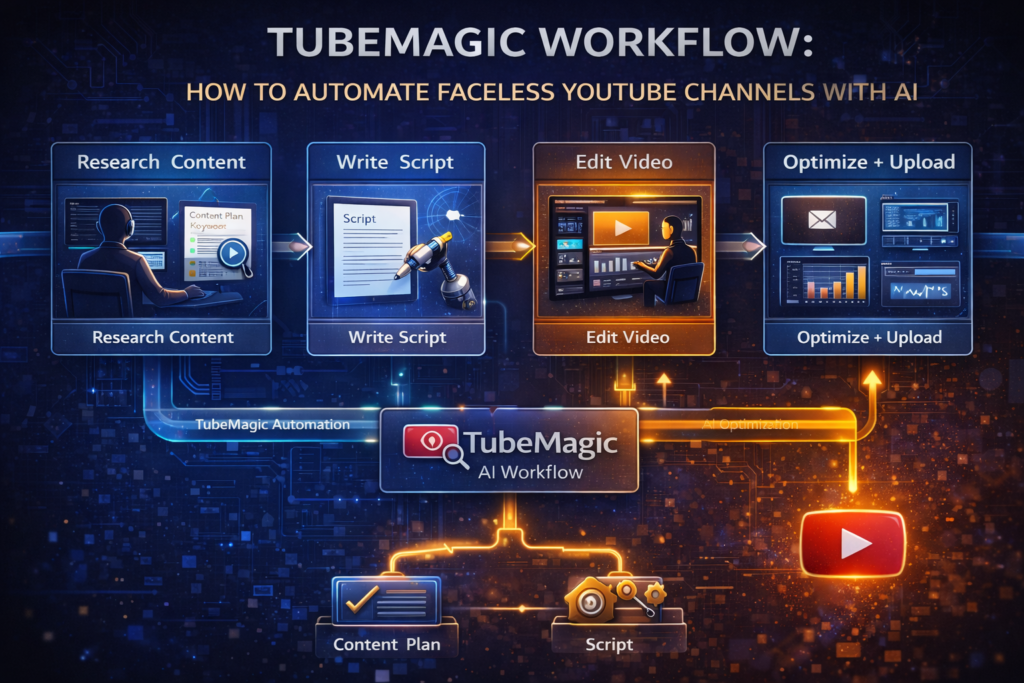
To reduce human intervention, integrate AI tools to generate scripts and research content. Instead of spending hours researching, use AI to summarize articles or transform success stories into professional YouTube scripts (intro, points, conclusion).
- 🎙️ Convert scripts into natural human voices using AI. Choose deep, professional voices for finance/stock market niches, or energetic voices for sports. Use AI to find stock videos matching your script and generate unique images that others don’t have.
- 🎬 Tools like Pictory can automatically sync video with voiceover and generate on-screen captions, increasing engagement significantly for faceless channels.

7- Visual Production and Editing Workflow
- ⏱️ Editing pace: Avoid static shots for more than 3–5 seconds. Change angles, zoom, or add moving text constantly to keep the viewer’s brain engaged.
- 🖼️ Support your script with relevant visuals. Images should serve the story, not just decoration. Example: if discussing financial loss, show dark colors or charts to reinforce the message. This alignment between script and visuals creates immersion and elevates content quality.
8- Thumbnail and Title Optimization
This stage is the first promotional step that decides whether the viewer clicks on your video. Use images that clearly show the event in a tempting way, adding a mysterious element or an arrow pointing to something interesting. Keep text minimal—one or two bold words are enough.
Rely on numbers instead of personal taste. Test two thumbnail styles and stick to the one that gets a higher click-through rate. Some channels even change the thumbnail after publishing if the video underperforms.
9- SEO and Discoverability Strategy
This stage ensures your videos reach the right audience. Before recording, confirm there’s interest in your topic. Use tools like vidIQ to identify high-demand or low-competition topics. Don’t guess what people want—follow the data.
- 🔍 Optimize your metadata to tell YouTube exactly what your video is about. Place keywords in the first 100 characters of the description and use tags directly related to your topic, like passive income, YouTube automation.
- 📈 YouTube is a recommendation engine. The more time viewers spend moving between your videos, the more YouTube promotes your content to new audiences.
10- Consistency and Content Scheduling
- 📅 Post consistently: one video per week at a fixed time, instead of 5 videos one week and nothing for a month. This signals the algorithm that your channel is active and trustworthy.
- 🤝 Build trust with viewers. Consistency encourages subscriptions, as the audience expects new content regularly. Over time, the algorithm understands your ideal audience, and each new video gains momentum, spreading faster than at the start.
- 🛡️ Use scheduling tools to upload videos in advance. This prevents burnout and creates a content library that brings in views and revenue even when you’re not actively working.
Conclusion
Success on YouTube in 2026 isn’t just luck with one video—it’s the result of a complete production system combining:
- Smart research – knowing what the audience wants
- The power of AI – speed and automation
- Consistency – building trust with the algorithm
- Data analysis – continuous improvement